Teaching to a Shrinking Room: Demographic Decline in South Korean Universities
 Aaron19 min read
Facts, Summaries, Sources
Compiled August 2026. A total of 63 English and Korean-language sources were consulted, including news and government policy documents. All sources were verified at the time of publication. The demographic and policy landscape here moves fast. Several stories broke in summer 2026. Expect further changes.
Part 1 — The Baseline: Korea’s Demographic Numbers
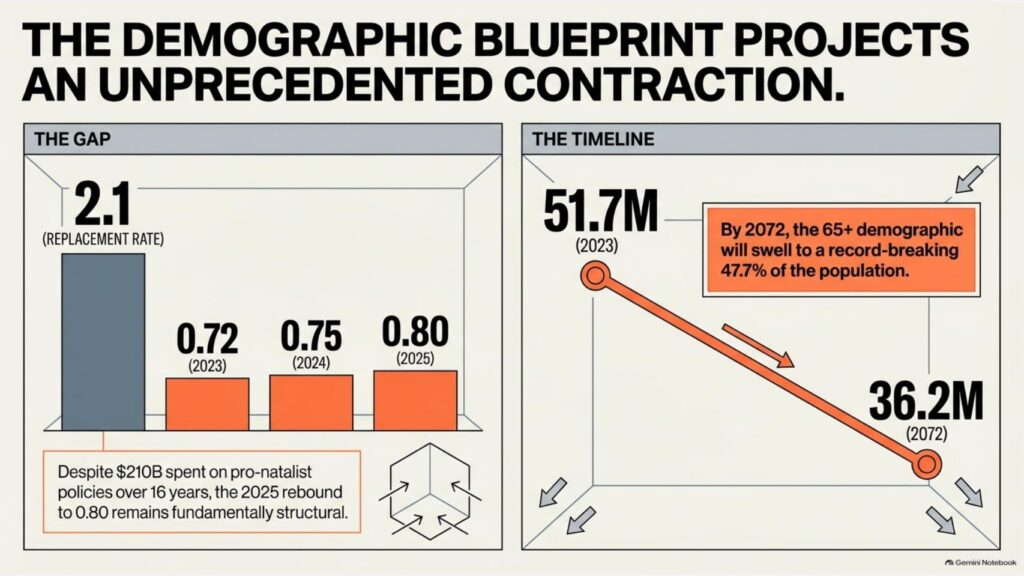
- Korea’s total fertility rate (TFR) fell to a world-record low of 0.72 in 2023 (from 0.78 the year before), the lowest ever recorded for any country. Yahoo/UPI
- The rate has since ticked upward for two consecutive years: 0.75 in 2024, and 0.80 in 2025 — the first sustained rise in years, and the first time back in the 0.8 range since 2021. Births in 2025 reached 254,500, an 6.8% increase and the highest total since 2010. Korea.net / Ministry of Data and Statistics
- Even at 0.80, Korea remains roughly a third of the 2.1 replacement rate needed to hold population steady. CNBC
- Government has spent over 280 trillion won (~US$210 billion) over 16+ years on pro-natalist incentives (cash grants, parental leave, childcare, mortgage support). spacedaily/Al Jazeera
Population projections (Statistics Korea / UN):
- Population is projected to fall from ~51.7 million (2023) to 36.2 million by 2072 — a drop of more than 30% in under 50 years. Silvereco / Statistics Korea
- The share of the population aged 65+ is projected to rise from ~19% today to 47.7% by 2072 — compared to a global average of just 20.3% by that year. Korea would be the most aged society ever recorded. Silvereco
- A private Seoul think tank (Korean Peninsula Population Institute for Future) projects that under a medium scenario, population could fall to 11.15 million by 2125 — under the worst-case scenario, to 7.53 million, less than the current population of Seoul alone. Korea Herald
- The working-age population (15–64) peaked in 2019 and is on a long downward slide; the dependency ratio (dependents per 100 working-age people) is projected to climb from ~38 (2020) toward 97+ by 2050. IJS Global Health
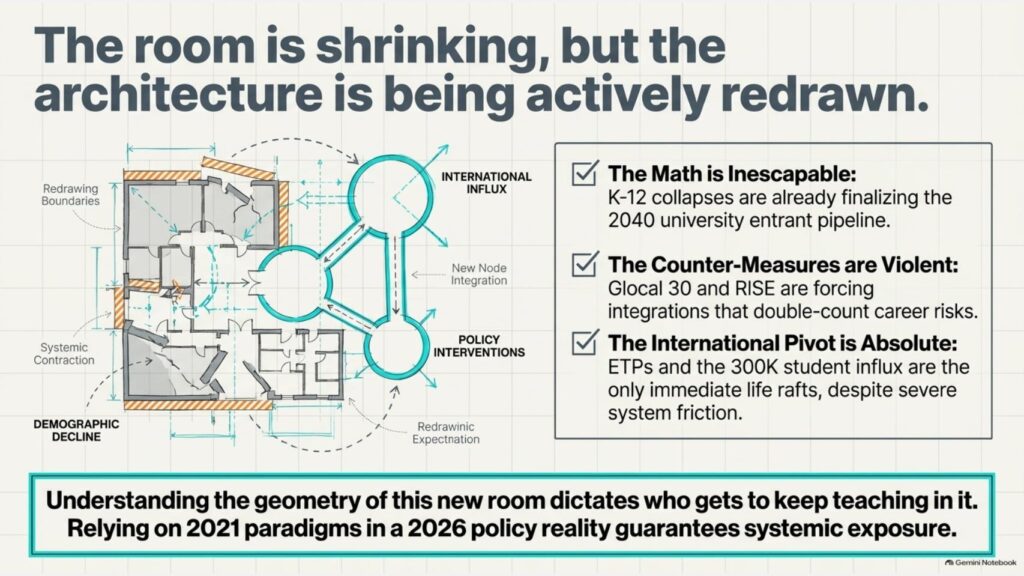
Key point: the rebound in births (2024–2025) is real but small against the scale of the coming contraction — even if “I heard the birth rate is going up now”.
Part 2 — Ground-Level Signs: What This Looks Like in Schools
This is all independently verifiable, and it maps almost exactly onto my own personal stories you already have.
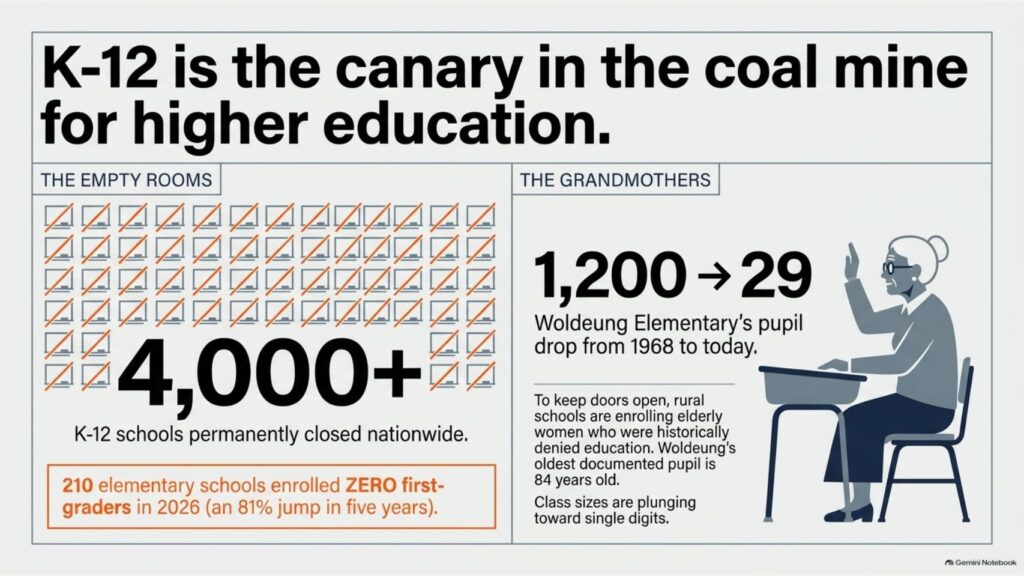
- Nationally, 210 elementary schools enrolled zero new first-graders in 2026 — an 81% jump from 116 such schools just five years earlier. Korea Herald, via VnExpress
- Over 4,000 K-12 schools have permanently closed nationwide as the student population has shrunk — 3,674 elementary, 264 middle, 70 high schools. Of the closed buildings, 376 remain unused (266 for over a decade), stuck in regulatory limbo about repurposing. AsiaDaily / Ministry of Education data
- The crisis has now reached Seoul — a school in Gangseo District had zero first-graders for the first time (previously, Seoul’s zero-enrollment schools had all been under reconstruction, not genuinely empty). VnExpress
- Gangwon Province alone: 20 schools had zero first-graders, 21 more had exactly one, and the province lost 121 elementary classes year-over-year. AsiaDaily
- Average elementary class size nationally is already sliding (20.4–21.1 students as of 2024–25 in surveyed provinces); experts project it could fall into the single digits within 10 years. Korea Herald
- 2025 saw 49 K-12 schools close nationwide, up from 33 in 2024 and 22 in 2023 — 88% of them in rural areas. The Independent
The “grandmothers in first grade” story is well documented and pre-dates 2026, but is still active: rural schools facing extinction have enrolled elderly women — many illiterate because they were denied schooling as girls — to keep classes open.
- Daegu Elementary in Gangjin County had ~90 students per grade level in the 1980s; by the time it recruited eight women aged 56–80 as first-graders, it had 22 students total. SBS / MyModernMet
- Woldeung Elementary went from 1,200 pupils (1968) to 29 children, and its oldest documented pupil was 84 years old. spacedaily, NYT-sourced
Key point: Our own university department’s staff declined (35→5). This is the same underlying curve as the K-12 numbers, different institutional layer.
Part 3 — The University Enrollment Crisis (in numbers)
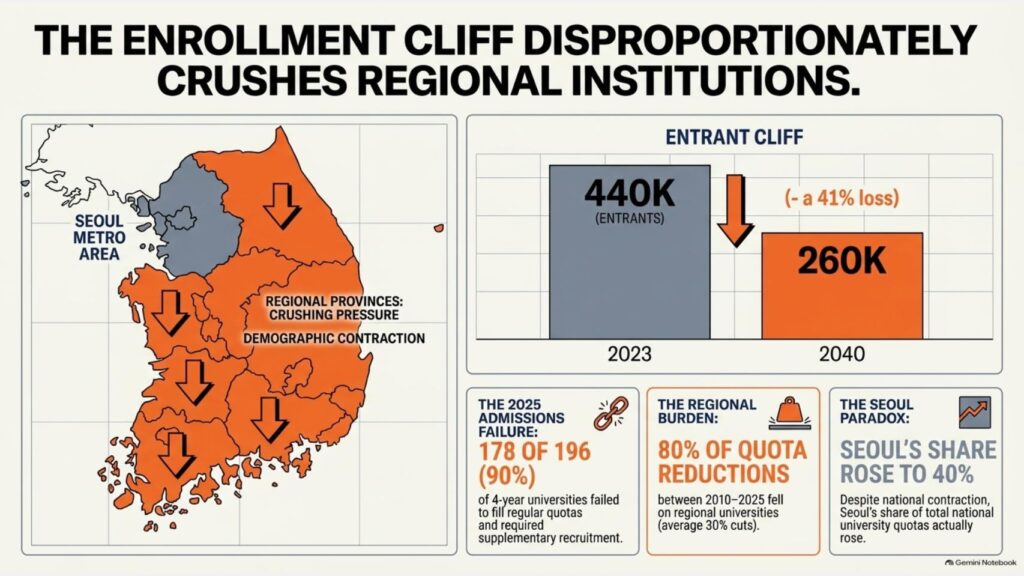
- Korean Council for University Education projects the number of university entrants will fall from 440,000 (2023) to 260,000 by 2040 — a 41% drop. Korea Times / British Council
- Since 2021, national university applicant numbers have fallen short of admissions quotas most years.
- In the 2025 academic year’s supplementary (“추가모집”) admissions round, 178 of 196 four-year universities nationwide (over 90%) failed to fill their quotas after the regular admissions period and had to open supplementary recruitment — 63% of those were regional (non-Seoul) universities. Yonhap/Daum
- Between 2010 and 2025, national university admission quotas fell by 122,000 seats (–21.4%) — but about 80% of that reduction fell on regional universities (~30% cuts) versus 11.8% in the greater Seoul area. Seoul’s share of total national quota rose from 36% (2010) to 40% (2025). Asia Economy Daily
- Regional breakdown of cuts:
- Gangwon (–32.7%),
- Jeju (–32.6%),
- Busan-Ulsan-Gyeongnam (–30.1%),
- Honam/Jeolla (–29.8%). Asia Economy Daily
Key point: the “shrinking room” isn’t evenly distributed — it’s a regional-vs-Seoul story as much as a national one, and it maps onto exactly the Jeonbuk/regional-university experience I have.
Part 4 — The Government’s Policy Response
4a. Tuition: an 18-year freeze just ended
- Korea’s Ministry of Education used a “Type II National Scholarship” mechanism since 2012 to effectively force universities to freeze or lower tuition (universities that raised tuition lost eligibility for this scholarship funding for their students). Korea Herald
- The freeze effectively held for 17 years, until Kookmin University became the first major university to raise tuition (4.97%) for the 2025 academic year. Korea Herald
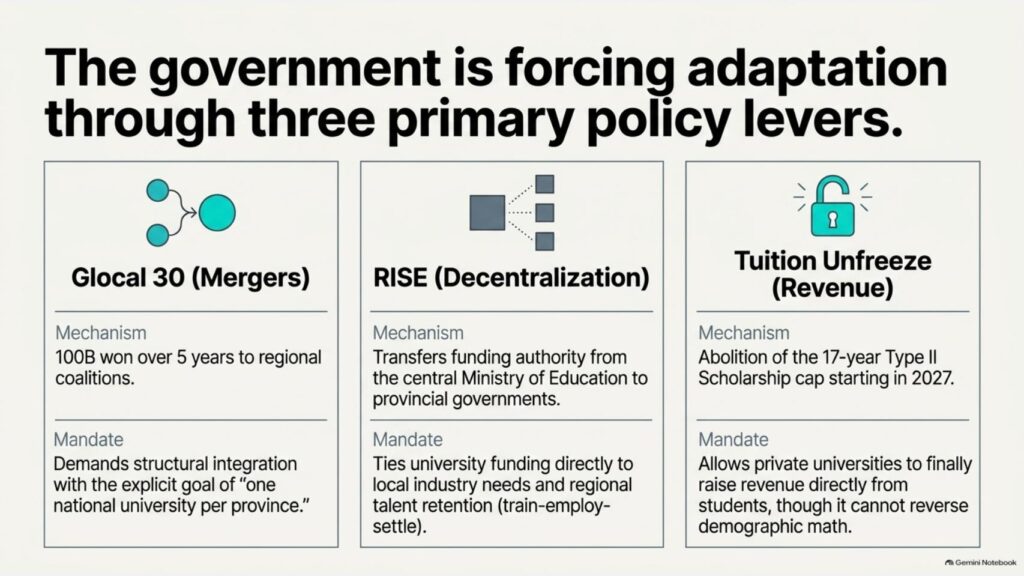
- On Dec. 12, 2025, the Ministry of Education announced it would abolish the Type II Scholarship program entirely starting 2027, ending the de facto freeze mechanism.
- Sogang University and Kookmin University immediately announced 2.5% and 2.8% hikes for 2026; the 154-member Korean Association of Private University Presidents had already said in Dec. 2025 it would file a constitutional complaint against the tuition-cap law. Korea Herald
Why this matters: the freeze/unfreeze is a direct, causal link between demographic-driven financial strain and a live 2025–2027 policy shift — very concrete and very recent.
4b. University mergers — confirmed, in progress, and historical pattern
Korea has been consolidating national universities in waves since the mid-2000s; the current wave is larger and openly framed around demographic survival, with an explicit government goal of “one national university per province.” Korea Herald
Earlier waves (context):
- Kangwon–Samcheok, Pusan–Miryang, Chonnam–Yosu, Kyungpook–Sangju (2006–2009);
- Gyeongsang–Gyeongnam Science & Tech (2021);
- Hankyong–Hankyong Welfare College (2023);
- Andong–Gyeongbuk Provincial (2025, into Kyungpook National University). Seoul Economic Daily
Mergers that opened for the March 2026 academic year:
- Kangwon National University + Gangneung-Wonju National University → merged as Kangwon National University, ~30,000 students, 4 campuses, the largest national-university admission quota in the country (~6,100). This is the first province-wide integrated national university in Korea. Korea Herald / Wikipedia
- Changwon National University + Geochang & Namhae Provincial Colleges → merged as Changwon National University (offers both associate and bachelor’s degrees; Geochang campus repurposed toward health care, AI, drones)
- Mokpo National University + Jeonnam Provincial University → merged as Mokpo University
- Wonkwang University + Wonkwang Health Science University Korea JoongAng Daily
Still in progress / planned:
- Chungbuk National University + Korea National University of Transportation — see full case study below (4c)
- Pusan National University + Busan National University of Education
- Suwon University + Suwon Science College Seoul Economic Daily
- Mokpo National University + Sunchon National University (South Jeolla) — merger explicitly pursued in part to justify establishing a new medical school and affiliated hospital for the province. Korea Times
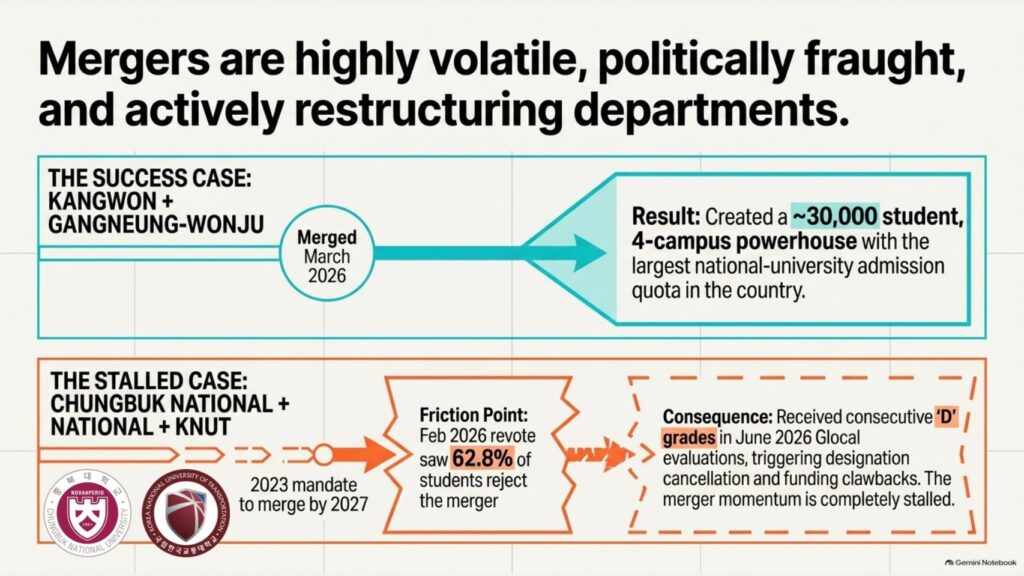
4c. Case study: Chungbuk National University + Korea National University of Transportation (KNUT)
This is not a footnote for me — I currently work at BOTH schools and it’s a live case study of everything this talk is about, playing out in real time at 충북국립대학교 itself. Timeline, most-recent-first context:
- 2023: Chungbuk National University (CBNU) and KNUT were jointly selected for Glocal University 30 funding (~100 billion won over 5 years) on the condition that they merge by March 2027. Namu Wiki
- Nov. 2024: Members voted to keep the name “Chungbuk National University” for the merged institution.
- Dec. 2025: A first member referendum on submitting the final merger application failed — KNUT’s students, staff, and faculty all favored it, but all three CBNU constituencies voted against, and CBNU had required majority support from at least two of three groups. CBNU’s president resigned, taking responsibility. 중부매일 / 한국대학신문
- Jan.–Feb. 2026: The merger was revived after renegotiation; a re-vote on Feb. 12–13, 2026 passed — faculty 69.0% in favor, staff 59.7% in favor, but students voted 62.8% against. The two schools formally submitted a merger application to the Ministry of Education on Feb. 19–22, 2026, with a target of a March 2027 launch (staged: administrative integration 2027, academic integration 2028). Namu Wiki / 중도일보
- Spring 2026: A contested single-campus presidential election process at CBNU (seen by some KNUT stakeholders as sidelining KNUT) further strained trust between the two schools’ communities; Chungju-based civic groups and the KNUT alumni association opposed elements of the process. 충북일보 headline archive, via 아이뉴스365
- June 30, 2026: In the annual Glocal University performance evaluation, CBNU–KNUT received the lowest grade (D) for insufficient/delayed progress on reform tasks (department consolidation, campus specialization, organizational restructuring) — their second consecutive D, which triggers designation cancellation under the program’s rules, along with a requirement to return the funding already disbursed. Nate News / 충청매일
- July 2026: Local reporting describes the merger as having “lost its driving momentum” for the March 2027 target, and CBNU replaced its acting president amid the fallout. As of the most recent coverage, the Ministry of Education’s approval process (national university merger review committee) and the Glocal designation cancellation are formally separate tracks — cancellation of Glocal status does not automatically kill the merger, but it removes the funding and political momentum that was driving it. 아이뉴스365
Bottom line, (and honestly, for my own planning): as of this writing, the CBNU–KNUT merger is stalled and in genuine doubt, not confirmed — it’s moving roughly monthly. It is, however, a nearly perfect live illustration of this talk’s core claim: that these policies “restructure departments in real time,” including the ones I’m currently working in.
4d. Glocal University 30 — the funding mechanism behind most of this
- Launched by the Ministry of Education in March 2023. Selected universities/coalitions (outside greater Seoul) receive ~100 billion won (~US$75.6 million) each over 5 years, plus regulatory flexibility, in exchange for structural innovation commitments — usually mergers, campus specialization, or curriculum overhauls. Total program budget: 3 trillion won across 30 designations. Korea JoongAng Daily / Namu Wiki
- Selection rounds:
- 10 designated in 2023,
- 10 in 2024,
- 5 in 2025,
- with a planned 5 more in 2026 (later changed to no new 2026 round). Namu Wiki
- 2023 cohort included:
- Gyeongsang National University,
- Sunchon National University,
- University of Ulsan,
- Jeonbuk National University,
- POSTECH, and
- Hallym University (standalone),
- plus four merger coalitions including Kangwon+Gangneung-Wonju and Chungbuk National University + KNUT. Korea JoongAng Daily
- Universities that receive funding but then fail their merger/reform milestones face a two-strikes cancellation rule (two “D” grades in the annual performance review triggers designation cancellation and clawback of funds) — as CBNU–KNUT experienced in June 2026. 충청매일
4e. RISE (지역혁신중심 대학지원체계) — the bigger structural shift
- RISE (“Regional Innovation System and Education”) transfers authority over university funding from the central Ministry of Education to provincial/metropolitan governments, piloted in select regions 2023–2024 and rolled out nationwide starting 2025. Ministry of Education / korea.kr
- Each province develops a 5-year RISE plan (2025–2029) tying university support directly to regional industry needs, local talent retention (“양성-취업-정주,” i.e., train–employ–settle), and — explicitly — international student attraction tailored to local labor needs. Worldfolio/MOE interview
- This is the mechanism by which the “300K international students” policy and regional survival policy are formally linked: local governments are now empowered (and expected) to recruit international students specifically to offset local demographic decline, not just to internationalize campuses in the abstract.
Part 5 — The International Student Push
5a. Study Korea 300K Project — target and status
- Launched by the Ministry of Education in August 2023, aiming to attract 300,000 international students by 2027 and place Korea among the world’s top-10 study-abroad destinations. Korea Times / Ministry of Education (English)
- Baseline: 207,125 international students as of June 2023 (17.6% YoY growth at the time). The 300K target represented roughly a 30% increase over five years. ICEF Monitor
The target has effectively already been hit, ahead of schedule.
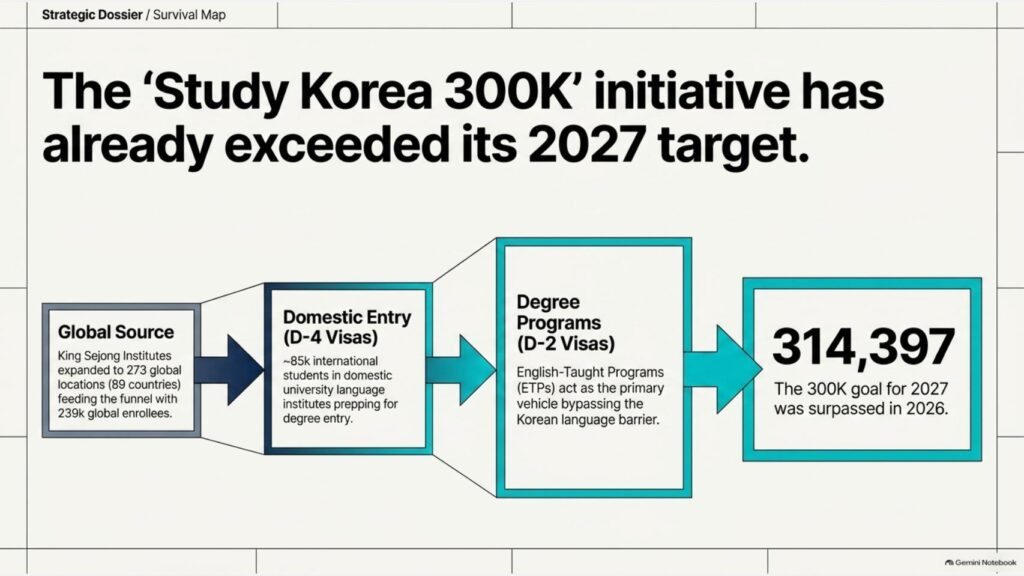
- Ministry of Justice data put the number of international students in Korea at 314,397 in 2026 (on D-2/D-4 visas), a ~15% rise from the prior count and past the original 300K goal. Studies-Overseas / Mysto
- Ministry of Education’s own enrolled-student count (a narrower measure than Justice Ministry visa-holder counts) was 253,400 for 2025. Study International
- Growth trajectory for context:
- 2018–19 ≈140,000–160,000 →
- 2023: 181,842 →
- 2024: 208,962. Wikipedia, sourced to MOE/KOSIS
- Related policy levers rolled out alongside the target:
- expanded work hours for international students (20→25 hrs/week),
- fast-tracked permanent residency for graduate degree-holders (6 years → 3 years),
- more STEM and non-STEM scholarships, and
- eased Korean-language proficiency requirements for admission. Erudera / ICEF Monitor
5b. KAIST’s 30%-by-2030 target — recent headline
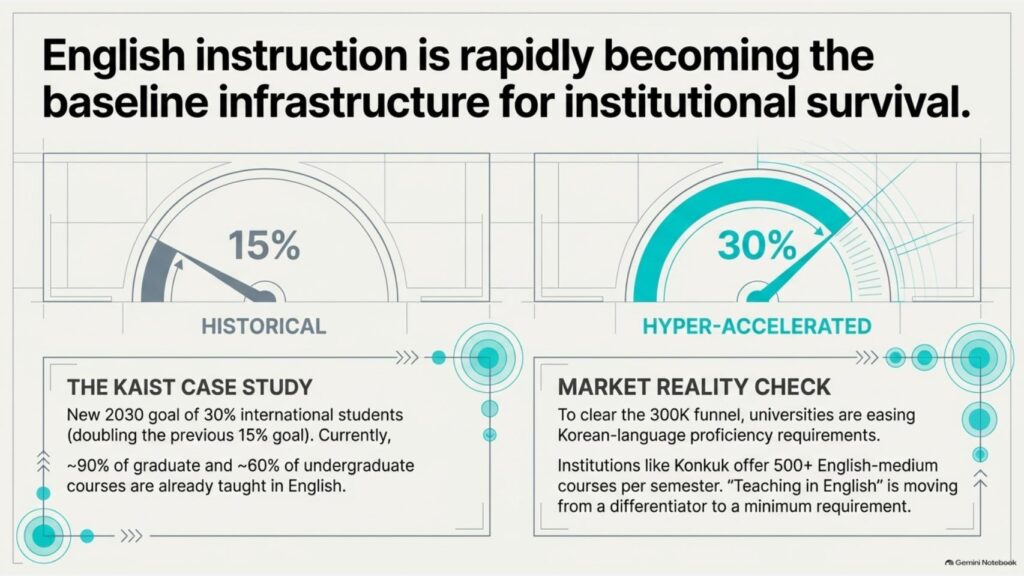
- KAIST President Bae Choong-sik, who took office in mid-August 2026, stated in an exclusive interview with The Korea Herald that he wants to double the share of international students to 30% by 2030.
- Current share: 10–15%. His own words: “the 30 percent goal is a challenging one.”
- He frames it not as simply raising headcount but as building dual-degree pathways and ensuring incoming international students and researchers can genuinely collaborate with Korean peers. He describes the strategy as continuing his predecessor’s “Global Twin” initiative into a new “Global Connect” phase emphasizing two-way researcher/student mobility. The Korea Herald, direct source
- For historical trend context: KAIST’s previous president (Lee Kwang-hyung, inaugurated 2021) had set a target of 15% international students/faculty, up from 9% at the time. Times Higher Education — so the 30% target represents roughly a doubling of the previous doubling goal, illustrating how fast the ambition curve is climbing at the flagship science university.
5c. English-taught program (ETP) growth
- English-taught programs (ETPs) are explicitly described by the Ministry of Education as “the primary vehicle” for reaching the Study Korea 300K target, since they remove the Korean-language barrier to enrollment. Admissions.kr
- KAIST:
- ~90%+ of graduate courses,
- ~60% of undergraduate courses taught in English. Admissions.kr
- Konkuk University:
- over 70% of courses taught entirely in English;
- 500 English-medium course offerings per semester;
- ~70 international faculty. Study International
- Yonsei’s UIC (Underwood International College):
- 100% English-taught undergraduate programs. Overseas Education Lane
- For Fall 2026, several universities (Sungkyunkwan, Korea University, others) expanded English-track admissions and scholarships, and in some cases dropped Korean-proficiency proof requirements for a wider range of programs to widen the applicant funnel.
- Korea University is simultaneously tightening its own language-proficiency verification process starting Spring 2027 (discontinuing its in-house Online Korean Level Test option) — a sign the system is still calibrating quality control against volume growth. Korea JoongAng Daily
5d. Korean-language education growth (both directions — abroad, feeding students in; and domestically, for those arriving)
Abroad (feeder pipeline — King Sejong Institute):
- The King Sejong Institute (Ministry of Culture, Sports and Tourism) network has expanded from 13 institutes in 3 countries (2007, 740 students) to 273 institutes in 89 countries (mid-2026). Seoul Economic Daily
- Total global enrollment across the network hit a record 239,020 students in 2025. Korea Times
- Government plans to expand to 350+ institutes by 2030. Language Magazine
- This year’s designation round drew applications from 94 institutions across 43 countries — an 8.5-to-1 competition ratio, the highest ever recorded. MCST official release
Domestically (language institutes inside Korea, feeding degree programs):
- As of end-2024, 85,173 international students were in Korea on D-4 (language-training) visas versus 179,581 on D-2 (degree) visas — meaning roughly a third of all international students in Korea are here specifically for intensive Korean-language study, typically as a pipeline into degree programs. Korea Herald
- University-run Korean language institutes (어학당) are the primary domestic delivery mechanism for this pipeline, and their expansion has tracked the broader 300K push, though comprehensive national enrollment figures for university language institutes specifically are less centrally published than the King Sejong or D-4 visa numbers above — this is a data gap.
Part 6 — The Honest Complication: Concerns and Critiques
This talk is meant to be “a map, not a warning” — and therefore it also needs to show the cracks in the international-student strategy, not just the ambition. This section is evidence for that balance.
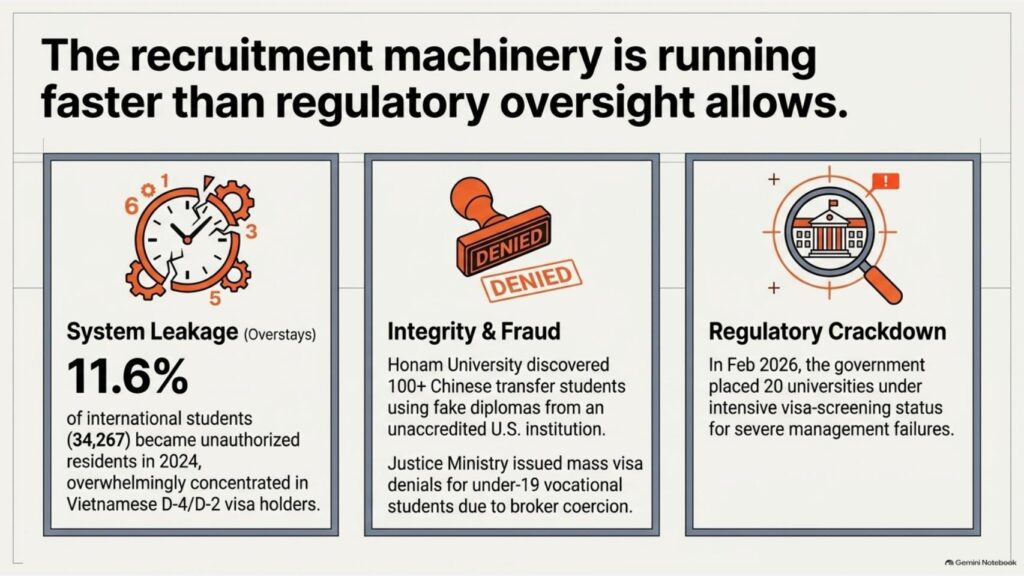
- A January 2026 academic study (Gangneung-Wonju National University, Prof. Kim Gyu-chan, published in the Korea Journal of International Migration) found that 34,267 international students became unauthorized residents in 2024 — either overstaying visas or working beyond permitted limits — more than five times the 2014 figure (6,782). This represents 11.6% of all international students that year, down from a peak of 15.7% in 2022 but still structurally elevated. Korea Herald / Korea Times
- The violation rate is heavily concentrated by visa type and nationality: 88.9% of D-4 (language-trainee) visa violators were Vietnamese nationals; among D-2 degree-track violators,
- Vietnam was also the largest group (~70%),
- followed by Uzbekistan (13%),
- Mongolia (6.9%),
- China (3.4%). Korea Herald
- The study attributes this partly to structural visa mismatches:
- D-10 job-seeking visas restrict income severely, while
- E-7 skilled-worker visas require salary thresholds many small/medium Korean employers can’t meet — especially for humanities/liberal-arts graduates — pushing some graduates toward unauthorized work rather than legal transition. VnExpress
- In February 2026, the Ministry of Education and Ministry of Justice jointly placed 20 universities under intensive visa-screening status (16 for degree programs, 4 for language programs) following their annual internationalization/management review — a direct regulatory response to recruitment and oversight failures at specific institutions. Seoul Economic Daily
A documented fraud case: authorities at Honam University found signs that 100+ Chinese students transferred into undergraduate programs using fake diplomas from an unaccredited U.S. institution, via a “3+1” transfer pathway — raising broader integrity questions about the financial incentives driving recruitment (a 2025 Korea Educational Development Institute study found international-student tuition has become a significant revenue driver across university tiers). Korea Herald
- Separately, visa denials have also hit the youngest and most vulnerable end of the pipeline: 167 international students under 19 were denied visas for vocational-school programs in the 2026 academic year after Justice Ministry officials flagged child-safety concerns — illegal brokers, misleading recruitment pitches, and risks including coercion and forced labor in some vocational-student recruitment schemes. Korea Herald
Key point: this is the difference between “Korea is recruiting international students to survive” and “Korea is recruiting international students to survive, and the recruitment machinery is still being built while it runs” — the latter is a much more honest and useful frame.
Part 7 — What This Constellation of Policies Means for Lecturers and ESL/English Teachers
(This section is analytical synthesis connecting the sourced facts above to my own professional situation — not itself a set of separate sourced claims, but a bridge.)
Full-time-to-adjunct ratio pressure is structural, not incidental.
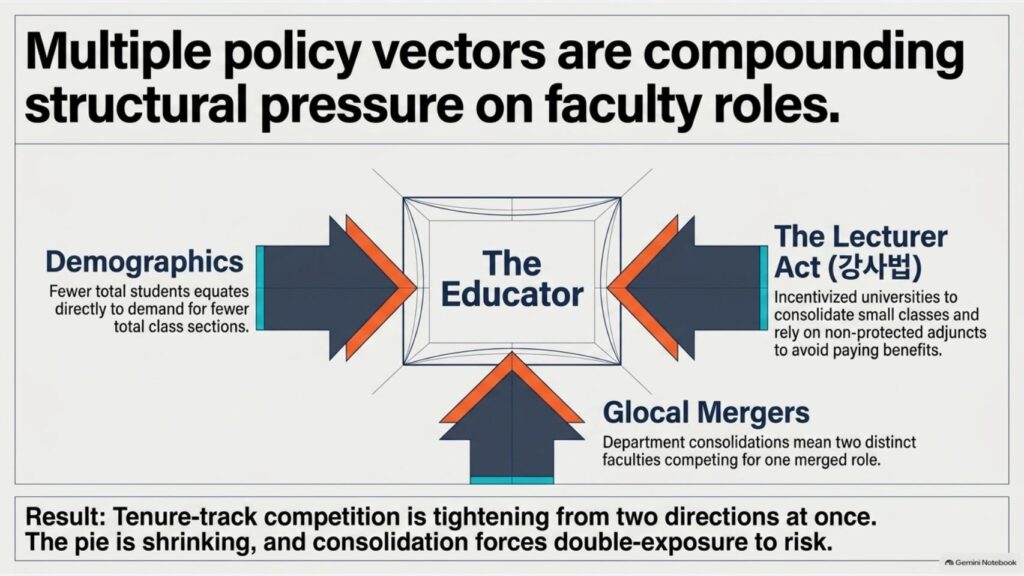
The 강사법 (Lecturer Act, effective 2019) was meant to convert precarious 시간강사 into more stable, benefits-eligible positions — but it also gave universities a direct financial incentive to consolidate small classes into large ones and lean more on 겸임/초빙 (adjunct/visiting) categories that fall outside the law’s protections. Layer declining enrollment and admissions-quota cuts on top of that incentive, and the structural pressure toward fewer, larger course sections — and fewer standalone lecturer positions — compounds rather than offsets.
Mergers double-count risk, not just opportunity.
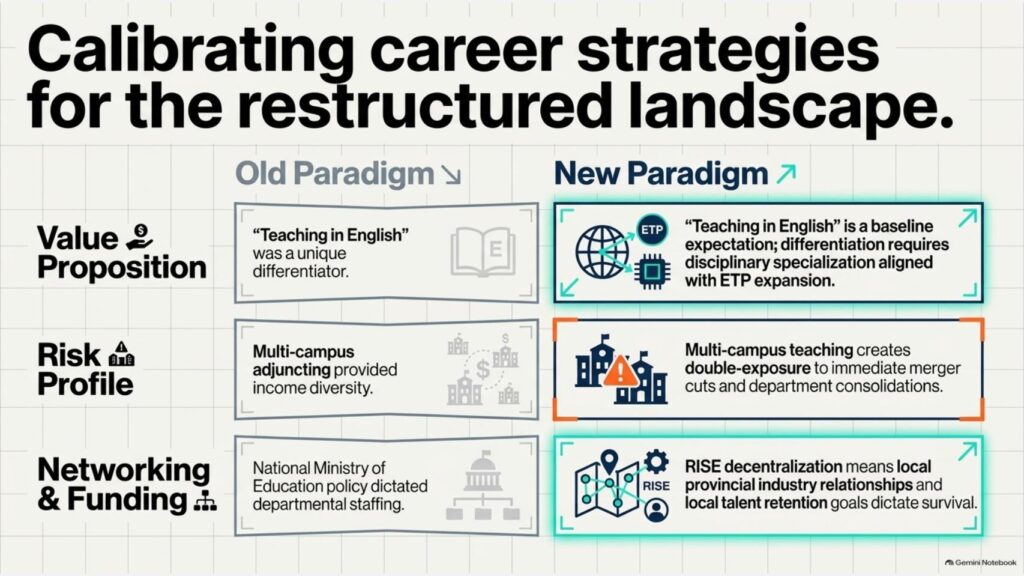
If you teach across two institutions that later merge (as is happening, contentiously, at my own institutions), you don’t necessarily gain a bigger combined role — you may simply lose one of the two positions once departments consolidate. The CBNU–KNUT case above is the concrete version of the abstract worry you named.
English-medium instruction is simultaneously your biggest advantage and your biggest exposure.
The 300K push and ETP expansion mean strong, sustained institutional demand for people who can teach content in English to a genuinely international classroom — which plays directly to my own credentials. But it also means the competitive field for those same roles is nationalizing and professionalizing quickly (see KAIST’s English-instruction percentages, the ETP guide above): “can teach in English” is rapidly becoming a baseline expectation at flagship and Glocal-funded institutions, not a differentiator.
RISE decentralization changes who you need to build relationships with.
Because funding authority is shifting from the central Ministry of Education to provincial governments, department-level staffing decisions for Glocal- or RISE-funded initiatives will increasingly track local industry and government priorities, not just national policy. Proactive relationship-building with local RISE committees and provincial education offices may become as relevant to job security as a strong publication record.
Tenure-track competition is about to tighten from two directions at once.
As mergers consolidate departments and enrollment-linked funding shrinks the overall pie, fewer institutions are chasing the same or growing pool of PhD-holding applicants — while the newly-freed tuition regime (post-2027) may partially offset university revenue pressure, but won’t reverse the underlying demographic math driving consolidation.
Part 8 — Full Source List
Demographics & fertility
- Korea Herald — [Q1 2025 birth rebound]
- Korea.net / Ministry of Data and Statistics — [2025 birth data]
- CNBC — [Birth rate collapse threatens growth]
- Yahoo/UPI — [2023 record-low fertility]
- Al Jazeera — [2022 fertility record]
Long-run population projections
- Korea Times — Population could plunge to 15% of current level in 100 years
- Silvereco (citing Statistics Korea) — [Unprecedented demographic crisis]
- Korea Herald — [Population could drop 85% in 100 years]
- IJS Global Health — [Aging population: burden or opportunity]
School closures / rural education
- VnExpress (Korea Herald/Chosun Ilbo sourced) — [Empty-class crisis reaches Seoul]
- AsiaDaily — [Empty Classroom Crisis]
- Korea Herald — [New elementary pupils plummet]
- Al Jazeera — [Grandmas saving Korea’s schools]
- spacedaily (NYT-sourced) — [Rural schools enrolling grandmothers]
- The Independent/AOL — [Almost 50 schools closing 2025]
University enrollment crisis
- British Council / Korea Times — [Declining enrolments push mergers]
- Asia Economy Daily — [학령인구 급감 지방대 붕괴]
- Daum/Yonhap — [90% of universities in supplementary admissions]
Tuition policy
- Korea Herald — [Private universities rush to hike tuition]
- Korea Herald — [17-year tuition freeze ends]
- Korea Herald — [Ministry to ease tuition control from 2027]
University mergers
- Korea Herald — [Three public university mergers approved]
- Seoul Economic Daily — [Korean university mergers stall]
- Times Higher Education — [It’s really all about survival]
- Korea JoongAng Daily — [National universities open as merged institutions]
- Korea Times — [University mergers/vocational pivot]
- Wikipedia — [Kangwon National University]
Chungbuk National University + KNUT case study
- Namu Wiki (English) — [Glocal University 30]
- Namu Wiki — [Korea National University of Transportation]
- 중부매일 — [충북대 반대, 교통대 찬성… 통합 사실상 무산]
- 한국대학신문 — [충북대, 통합 반대 우세]
- 중도일보 — [통합신청서 교육부 제출, 2027년 3월 목표]
- Nate News — [글로컬대학 퇴출 위기, 통합 동력 흔들]
- 충청매일 — [통합 3년 공든탑 무너지나]
- 아이뉴스365 — [행정·학사 단계적 통합 공식화 / headline archive]
RISE initiative
- korea.kr policy briefing — [지역혁신중심 대학지원체계 구축]
- 정책브리핑 — [2025년 RISE 도입 본격 시동]
- Ministry of Education RISE strategy document — [지원전략 2025.4]
Study Korea 300K / international students
- Ministry of Education (English) — [Study Korea 300K announcement]
- ICEF Monitor — [300,000 by 2027]
- Erudera — [South Korea plans to attract 300K]
- The Worldfolio (MOE interview) — [MOE explains Study Korea 300K / RISE link]
- Wikipedia — [International students in South Korea (data table)]
- Studies-Overseas — [314,397 international students, 2026]
- Korea Times — [Beyond numbers: support gap]
KAIST internationalization
- Korea Herald — [KAIST president targets 30% by 2030 — primary source]
- Times Higher Education — [Previous KAIST president’s 15% target, 2021]
English-taught programs
- Admissions.kr — [English-Taught Programs in Korea: 2026 Guide]
- Study International — [10 best Korean universities for international students]
- Korea JoongAng Daily — [Fall 2026 English Track expansion]
Korean-language education growth
- Seoul Economic Daily — [King Sejong Institute at 20: 273 locations]
- Korea Times — [29 new King Sejong Institutes, 2026]
- Language Magazine — [Growing demand for Korean, new institutes]
- Ministry of Culture, Sports and Tourism (official) — [King Sejong Institute designation]
Concerns / critiques
- Korea Herald — [Foreign student push runs into visa wall]
- Korea Times — [1 in 9 international students become unauthorized residents]
- VnExpress — [Visa overstay study details]
- Seoul Economic Daily — [20 universities under visa screening]
- Korea Herald — [Diploma-mill / integrity concerns]
- Korea Herald — [Visa denials for under-19 vocational students]
시간강사 / 강사법 background
- 한국경제 — [강사법 영향, 강좌 감소]
- Namu Wiki — [강사법]
- 대학지성 In&Out — [강사법 시행령 보완 필요]


